.JPG)
a.jpg)

.JPG)


a.jpg)


.JPG)
a+(2).jpg)

Click on Link:
Chateau Lalinde : The perfect venue for your event
|
|
|
|
|

I recently came across a magazine - freely on offer on the counter of my little supermarket -- that I took home and read from cover to cover - finding the articles pertinent, well written and informative, and presented in a reader-friendly and attractive way.
In a market already well-supplied with various how-to and setting-you-on-your-way publications, this one appealed to me. It contains just enough to take in in one go.
Expats have no shortage of helpful publications, but often they are so packed with so much information that it is impossible to remember half of it -- let alone remember where to go look for it again when you need the information.
"Impressions" has just enough of a variety of things, and with the clearly defined content, coming back to the correct copy which contains the specific information you will need some time in the future, should be a diddle.
I decided to go look for the person behind this lovely little magazine, "Impressions".
Jon Burton is the man, and he was ready to tell me more:

A: Thank you for your kind words regarding Impressions magazine.
The magazine was launched in April 2003 in the Deux Sèvres department of the
Impressions magazine expanded rapidly in the Deux Sèvres and soon was being distributed in all departments of the Poitou Charentes. It now has a content of 28 pages, a readership of over 20,000 and carries 60+ advertisers.
Q: So it is not a new magazine?
A: No, in the
Q: You say there are 60+ advertisers. Yet reading the magazine, one does not get that 'crowded' feeling with too many advertisements competing for space with the articles.
A: That is good, because it really is a symbiotic relationship ---- the advertisers are not only important to us, but to the reader as well, as they are the people that make up the networking system of the expat in his new home. And of course, the magazine is wholly funded by advertising revenue, keeping it free to the reader ----- thus generating greater exposure for the advertiser. Impressions magazine also has a large subscriber base of readers who have the magazine delivered to their door throughout the world. Being a well-established magazine already, it has become a much relied upon and successful medium and has many advertisers who have been advertising from issue one including Century 21, AXA insurance and local Notaires. Q: Interesting, because it is not a very 'big' magazine.
A: Yes, but we are confident we can replicate the success of the magazine here in the Dordogne and believe that Impressions magazine will be a good medium for businesses to advertise at a lower cost than other publications. --- Although Impressions magazine is starting as a 12 page magazine for the
Q: Ah! I hope not too big -- because that is exactly what I found was unique about it and made it so attractive to me as the reader -- the 'digestible' size!
A: And its availability, I hope! -----We are also pleased to announce that we have signed a partnership agreement with the Chambre de Commerce et Industry of Dordogne and the Bergerac Airport Authority. This will ensure that the magazine will be made available to a wider audience hence offering better coverage for advertisers.
As well as being available in the Arrival and Departure Halls at Bergerac Airport, 3000 copies of Impressions magazine will be distributed in restaurants, bars, tabacs, banks, supermarkets, immobiliers, Office de Tourisme and insurance offices, initially throughout the areas of:- Riberac, Bergerac, Eymet, Lalinde, Monbazillac, Saint Foy and Mussidan.
We wish Impressions much success in the Perigord Dordogne ---
Look out for it wherever you are and have a look for yourself --
and do let us know what you think about it!
 If you are looking for an activity holiday or simply the most enjoyable and most efficient way to get and keep fit and healthy, there cannot be too many forms of exercise that fit the bill better than Pilates and Fencing - and especially when the instructors are as good -- and as charming as Robyn and Patrick!
It is an Exercise in Balance : "I must be right. Never an aspirin. Never injured a day in my life. The whole country, the whole world, should be doing my exercises. They'd be happier.", said Jo Pilates in 1965, at the age of 86.
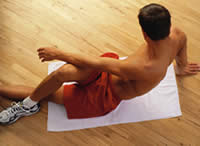
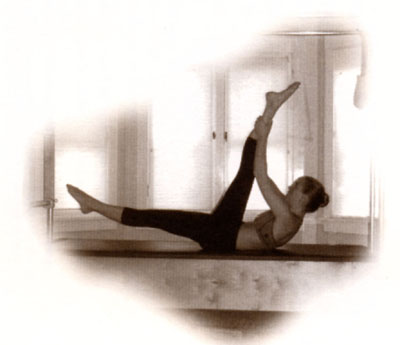 Practiced faithfully, Pilates yields numerous benefits. Increased lung capacity and circulation through deep, healthy breathing is a primary focus. Strength and flexibility, particularly of the abdomen and back muscles, coordination-both muscular and mental, are key components in an effective Pilates program. Posture, balance, and core strength are all heartily increased. Bone density and joint health improve, and many experience positive body awareness for the first time. Pilates teaches balance and control of the body, and that capacity spills over into other areas of one's life.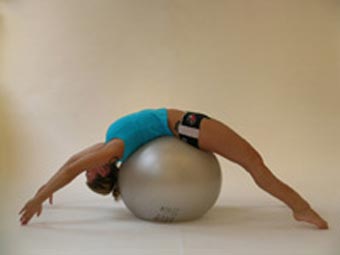
And now Pilates has come to the Dordogne as well! Robyn Haigh, from Lalinde,is a well established Pilates teacher in Lalinde as well as in Eymet and the larger Dordogne Perigord. She works both with groups and in one-on-one classes.
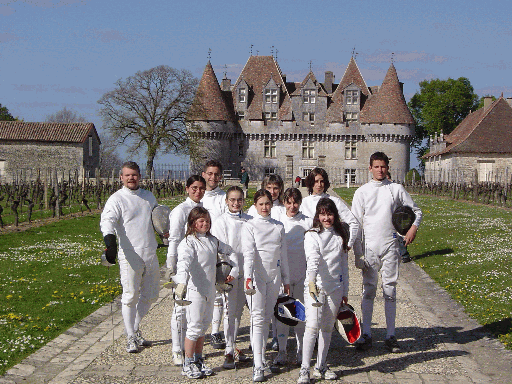
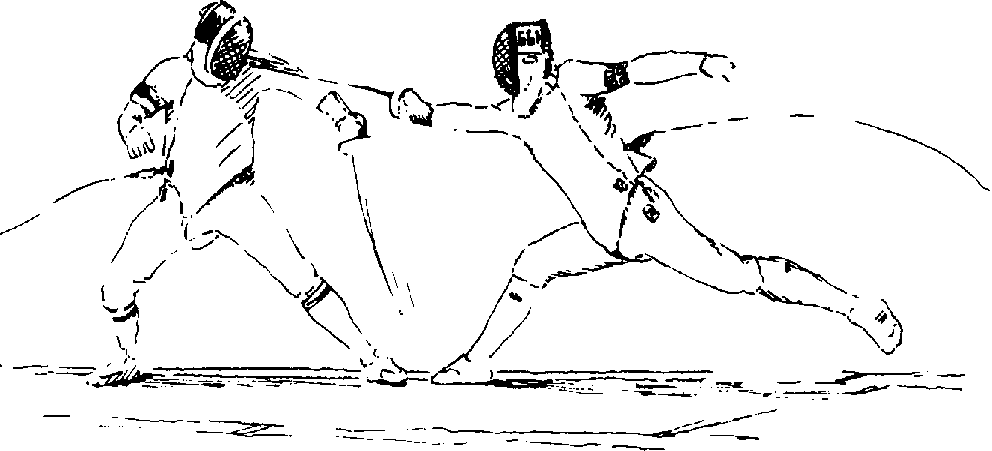
Fencing is a is a fantastic way to improve balance, co-ordination and flexibility - and it's great fun as well!
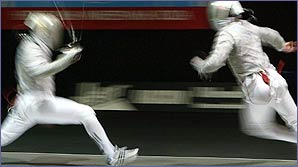 Fencing originated as the practice of swordsmanship to prepare men for duels and warfare. A fencing match is depicted on an Egyptian temple that dates to about 1190 B.C. and the ancient Babylonians, Greeks, Persians, and Romans all had some form of fencing. The use of armour during the Middle Ages made swordsmanship virtually obsolete. The broadsword was used against armour, but only as a crude hacking device requiring sheer strength rather than skill. By making armour obsolete, the development of firearms ironically brought swordplay back into prominence during the 15th century. Soldiers once again had to acquire some skill with the sword, and fencing also emerged as a pastime for gentlemen. Fencing masters organized guilds, which taught various moves to initiates while protecting them as trade secrets from outsiders.


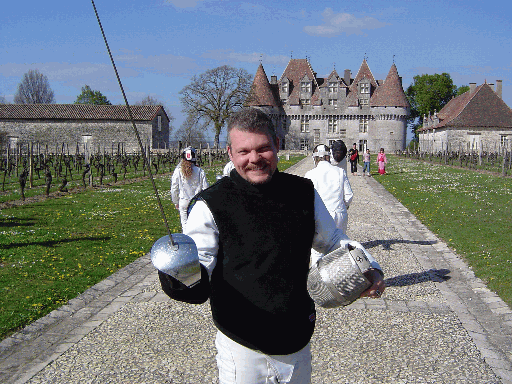 Fencing is one of only four sports that have been on every modern Olympic program since 1896. The Fédération Internationale d'Escrime, founded in 1913 to standardize rules, is the governing body for international fencing, including the Olympics.
Patrick is a sabreur(sabre fencer), and has received many wonderful medals and awards and acclaim at the Championnats de France and other European events.
Last year he also became Champion d'Aquitaine (Vétéran V1 Individuelle) at Mont de Marsan at the Championnats de Ligue Vétéran, again at Epée --- and after beating the Maitre d'armes of Périgueux in the quarter finals, and his club president in the semi!